
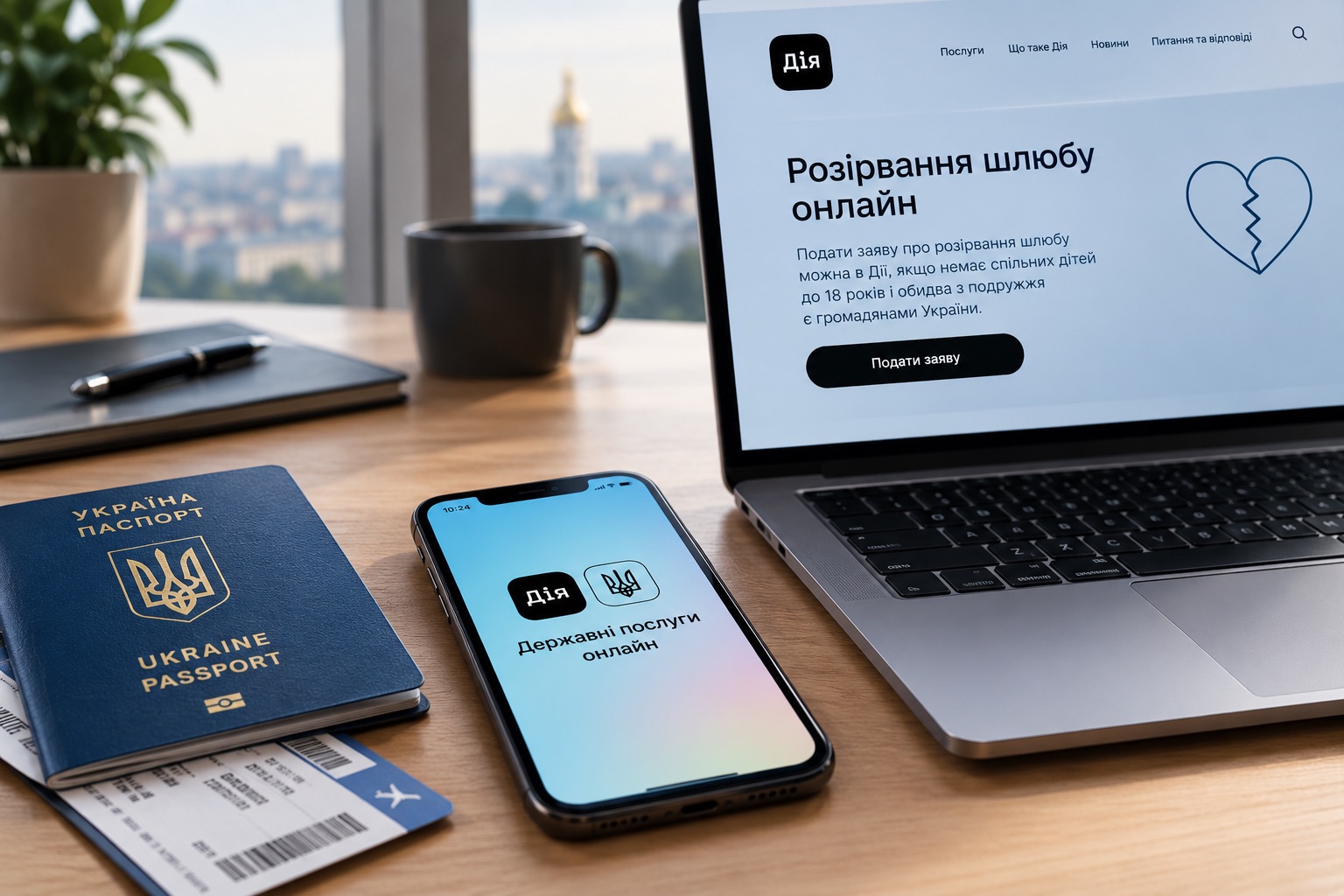
In September 2026 Ukraine launched a fully online divorce service in the Diia app, and it works exactly as advertised: two people can end a marriage from their phones without ever entering a registry office. But an online divorce in Ukraine through Diia is available only when both spouses are Ukrainian citizens with a verified digital identity, a Ukrainian tax number and an active Diia.Signature. If one spouse is a foreign national — or if either spouse lacks a Ukrainian ID card or biometric passport — the Diia route is closed. That does not mean divorce in Ukraine is closed to you. It means you use the traditional channels, which remain fully available and can still be handled remotely through a Ukrainian attorney.
This post explains what the new service actually does, why it is worth knowing about even if you cannot use it, and what foreign citizens should do instead.
What is the new Diia online divorce service?
The service was developed jointly by Ukraine’s Ministry of Justice and the Ministry of Digital Transformation and is described on the state portal’s own divorce service page. It moves the administrative (non-judicial) divorce procedure — the one handled by the civil status registration bodies, known as DRATS or RATSU — entirely into the state’s mobile application.
The procedure runs in five stages:
- Application. One spouse files the application in Diia and selects a slot for a video meeting. The earliest available slot is one month and two days after filing, because Ukrainian law requires a mandatory one-month reflection period.
- Confirmation by the second spouse. The other spouse has 12 hours to confirm the details and sign with Diia.Signature. If they do not, the application lapses.
- Registry checks. The system verifies the data against the State Register of Civil Status Acts and other state registers — including, critically, whether the couple has common minor children.
- Video conference. Both spouses join a video call with a registry official and confirm their intention to divorce.
- Result. The electronic civil status record is created within 24 hours. Paper certificates are sent by Ukrposhta.
Either spouse can withdraw the application at any point before the divorce is registered.
Who can actually use it?
The eligibility conditions are cumulative. All of them must be met:
- both spouses are citizens of Ukraine, aged 18 or over;
- both consent to the divorce;
- the couple has no common minor children;
- both have a verified Ukrainian tax number (RNOKPP) and an active Diia.Signature;
- both hold a Ukrainian ID card or biometric international passport;
- the marriage is recorded in the State Register of Civil Status Acts.
The presence of common minor children is an automatic blocker — the system will not let the application through. That is not a software limitation but Article 106 of the Family Code of Ukraine, which reserves administrative divorce for childless couples. Everyone else goes to court.
Why can foreign citizens not divorce in Ukraine through Diia?
This is the part that generates the most confusion, so it is worth being precise: the barrier is digital identity, not family law.
Ukrainian substantive law does not condition administrative divorce on citizenship. A marriage registered in Ukraine between a Ukrainian and a foreign national, or between two foreign nationals, can in principle be dissolved administratively by a DRATS office if the couple consents and has no minor children. What a foreign national cannot do is authenticate into the state’s digital infrastructure. Diia.Signature is issued on the basis of a Ukrainian ID document and a Ukrainian tax number tied to a citizen’s record. Without that chain, there is no way to sign the application, and no way for the registry to verify identity in the automated flow.
Three practical consequences follow:
- A mixed marriage is ineligible. If a Ukrainian citizen is married to a foreign national, the Ukrainian spouse’s own access to Diia is irrelevant. The service requires both parties to qualify.
- A marriage not recorded in the Ukrainian register is ineligible. If you married abroad and never registered or transcribed the marriage in Ukraine, there is no record for the system to act on.
- Delivery is domestic only. Paper certificates are currently delivered by Ukrposhta within Ukraine. The authorities have said a mechanism for applicants abroad is being developed, but as of now that is a plan, not a procedure.
So the honest framing is this: the Diia divorce is a useful illustration of where Ukrainian legal procedure is heading, and a genuine convenience for a specific group of Ukrainian citizens. It is not a route available to foreigners, and any service offering to “divorce you through Diia” as a foreign national is misrepresenting what the application does.
What are the real options for a foreign citizen?
There are two, and both can be handled without you travelling to Ukraine.
Administrative divorce at a DRATS office. Available where both spouses agree and there are no common minor children. If one spouse cannot appear in person, their signature on the joint application must be certified by a notary — abroad, that means a notary in your country of residence plus an apostille or legalisation, and a certified Ukrainian translation. Timeline: approximately one month from filing.
Judicial divorce. Required when there are common minor children, when one spouse objects, or when the divorce is entangled with property or custody disputes. A Ukrainian attorney acts under an attorney’s warrant (order) and appears on your behalf; your physical presence is generally not needed. Timeline: typically two to six months depending on the court’s workload and whether the other side contests.
Which court or registry has competence, and whether Ukrainian law applies at all, depends on where the marriage was registered, the citizenship of each spouse and where each currently resides. Ukraine’s Law on Private International Law governs that analysis, and it is worth resolving before filing anything — a divorce obtained in the wrong forum can create recognition problems later in your home country.
I cover the jurisdictional test, the document set and the recognition question in detail in my guide to divorce in Ukraine for foreign citizens.
How do the three routes compare?
| Diia online divorce | DRATS (administrative) | Court | |
|---|---|---|---|
| Open to foreign citizens | No | Yes | Yes |
| Both spouses must consent | Yes | Yes | No |
| Common minor children allowed | No | No | Yes |
| Physical presence required | No (video call) | No, with notarised application | No, with an attorney |
| Typical timeline | ~1 month + 2 days | ~1 month | 2–6 months |
| Property division decided | No | No | Yes, if claimed |
Note that neither administrative route — Diia or DRATS — resolves property division or child arrangements. Those are separate matters, and in cross-border marriages they are usually the part that actually needs legal work.
Does this change anything for Ukrainians living abroad?
Partly. A Ukrainian citizen abroad who holds a valid biometric passport and an active Diia.Signature can technically satisfy the identity requirements — but the certificate delivery problem remains, and both spouses must still qualify. The Ministry of Justice has indicated that a cross-border mechanism is in development. Until it is published, Ukrainians abroad in a mixed marriage should plan on the consular or attorney-represented route rather than waiting for the app.
If you need the resulting certificate or an extract from the civil status register delivered outside Ukraine, that is a separate procedure — see how to obtain documents from Ukraine while abroad.
Will a Ukrainian divorce be recognised in my country?
Generally yes, but recognition is never automatic on the strength of a Ukrainian document alone. You will normally need the divorce certificate or the court decision with a mark of legal force, apostilled or legalised, and translated by a sworn translator in the country of recognition. Some jurisdictions additionally require a recognition procedure before a local court or civil registry. The requirements differ meaningfully between, for example, Germany, Poland, Slovakia and the United States, so the recognition step should be planned before the Ukrainian proceeding is filed, not after.
Getting help with a Ukrainian divorce as a foreign citizen
I am a licensed Ukrainian attorney working from Bratislava with international clients. If you are a foreign national married to a Ukrainian citizen, married in Ukraine, or holding a marriage that sits between two legal systems, I can assess which route applies to your situation, prepare the document set to the standard the registry or court will accept, and represent you in Ukraine so that you do not have to travel. Divorce, property division and child arrangements are part of my family and civil law practice.
The new Diia service is not the door for you — but there is a door, and it is a well-established one.
Get in touch with a short description of your situation — where you married, the citizenship of each spouse, whether there are minor children — and I will tell you which route applies and what it involves.
Frequently asked questions
Can I get an online divorce in Ukraine if I am a foreign citizen?
Not through the Diia application. The service requires both spouses to be Ukrainian citizens with a Ukrainian ID document, tax number and Diia.Signature. Foreign citizens divorce in Ukraine through a DRATS office or through the courts, both of which can be handled remotely with a Ukrainian attorney.
My spouse is Ukrainian and I am not. Can they use Diia and divorce me that way?
No. The application checks both spouses. A marriage in which one party is a foreign national does not qualify, regardless of the Ukrainian spouse’s digital status.
We have a child together. Does that block the online service?
Yes. The absence of common minor children is a statutory condition of administrative divorce under Article 106 of the Family Code of Ukraine. With a minor child, the divorce goes to court — including where both spouses agree.
We married abroad and never registered it in Ukraine. Does Ukraine have jurisdiction?
Possibly, depending on citizenship and residence, but the Diia service certainly does not apply, since it operates only on records already in the State Register of Civil Status Acts. This situation needs an individual jurisdictional assessment before anything is filed.
How long does a divorce in Ukraine take for a foreign citizen?
Roughly one month for an uncontested administrative divorce once the document set is complete and correctly certified, and typically two to six months for a court divorce, depending on the court and whether the case is contested.
Do I need to travel to Ukraine?
In most cases, no. An administrative divorce can proceed on a notarised and apostilled application; a court divorce can be conducted by a Ukrainian attorney acting under an attorney’s warrant.